





Blog
Array Layout and Installation Considerations for Solar Panel Cleaning Robots
Date: 2026-10-13
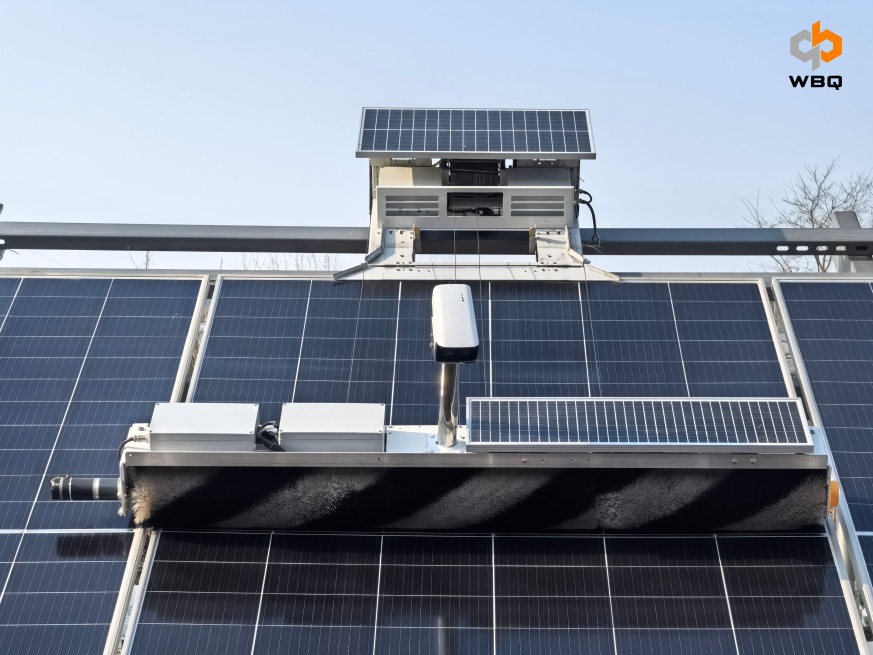
Plant capacity and total module area are useful starting points for a solar panel cleaning robot inquiry. They do not establish how the equipment will fit the array or complete its assigned work. For EPC procurement and construction teams, module layout, mounting interfaces, and the available cleaning window belong in the equipment discussion before the configuration is agreed.
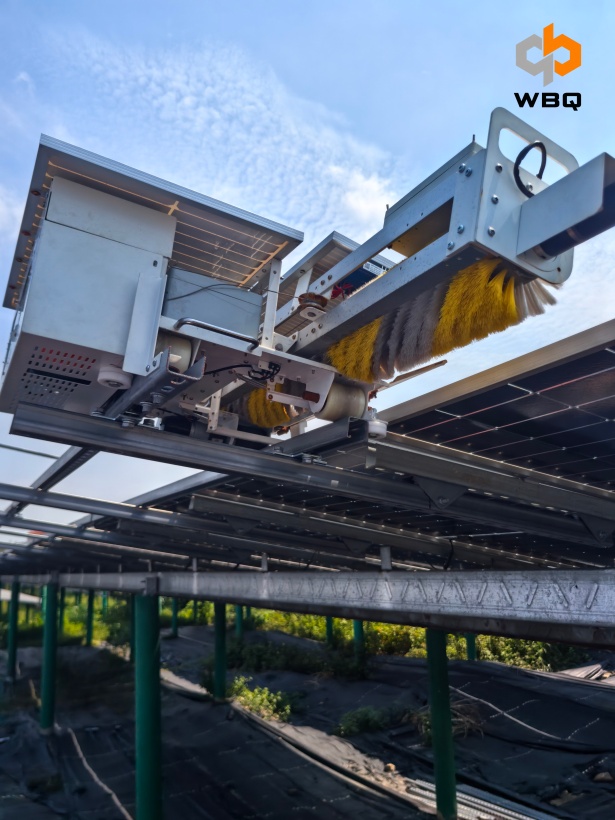
The WBQ-PVR25 uses a rail-mounted system with wire-rope-driven cleaning. A rail-mounted carriage travels along the array to position the cleaning roller for its next pass. A wire rope moves the roller up and down along the sloping module surface. The installation considerations below relate to this arrangement; other cleaning robot designs have different interface requirements.
Array Layout and Rail Attachment
An array drawing establishes module dimensions, portrait or landscape orientation, and the number of rows and columns in each section. Together with tilt, module gaps, and height differences between adjacent modules, these details help define the roller’s travel path and the rail layout. Discontinuities and pronounced changes in level need to be identified so the proposed cleaning area reflects the actual surface the roller will traverse.
The rail attachment also needs to be coordinated with the solar mounting structure. The equipment and mounting suppliers need to agree on fixing locations, connection details, and the loads transferred into the structure. Cables, projecting members, access routes, and maintenance clearances can affect the space available for installation and operation. A rail location marked on a drawing is only useful if the corresponding attachment and access conditions exist on site.
On a new project, this coordination can take place while the array and mounting design are being developed. At an existing plant, structural details and current photographs are needed to assess the installation and any required changes. Rooftop projects also need practical access arrangements for installation and later maintenance.
Cleaning Area and Operating Schedule
Two arrays with the same surface area can require different operating arrangements. Begin with the section to be cleaned, the interval between cleaning cycles, and the time available to complete each cycle. The proposed configuration can then be assessed against the roller’s return passes, carriage travel, battery operating time, and charging arrangements. Dividing the whole plant area by a nominal cleaning rate does not capture these requirements.
The WBQ-PVR25 includes PV charging and battery storage, with cleaning schedules and operating status managed through its platform. These functions allow equipment operation to be planned around the assigned area and available working periods. The charging and storage configuration still needs to match that schedule; a programmed cleaning plan alone does not establish when an entire area will be completed.
Describe the contamination as well as the area. Loose dust, bird droppings, oil, and hardened deposits present different cleaning demands. Close-up photographs and details of the current cleaning method help the supplier assess the brush and operating approach, including whether supplementary cleaning measures are needed. They also provide a starting point for agreeing how cleaning results will be assessed.
Module Contact and Structural Loads
In this arrangement, the carriage runs on the rail while the cleaning assembly works on the module surface. Rail attachment loads and roller contact therefore require separate assessment. One concerns how loads enter the mounting structure; the other concerns how the brush interacts with the module glass or surface coating.
Brush material, contact pressure, and movement need to be considered alongside the module manufacturer’s cleaning instructions. Total equipment weight does not describe the force at an individual contact location. For an existing plant, the exact module model provides a better basis for this review than module wattage alone.
If a trial is arranged, a representative section, documented contamination, and agreed inspection methods can make the results easier to interpret. Assessment can cover both cleaning results and the module surface after operation. Dust removal and changes in energy output remain separate measures; a cleaning result is not a direct energy-yield guarantee.
Scope of Supply and Maintenance Arrangements
To compare quotations, establish what each supplier includes. The scope of supply needs to distinguish the equipment, rails and fixings, PV charging and battery storage, communications, and platform services. It also needs to identify who handles installation and commissioning, training, consumables, and spare parts. Any changes to the mounting structure, site installation work, and acceptance procedures belong in the agreed project scope before delivery.
The WBQ-PVR25 connects to its management platform through 4G for operating-status monitoring and cleaning-plan management. Operating status can also be viewed through a mobile app and WeChat Mini Program. Check coverage at the installation area and agree on communications charges, platform access, and user permissions. Viewing equipment status remotely helps the team follow operation, while site personnel carry out physical inspections and component maintenance.
For the modular equipment, procurement discussions can cover how components are replaced on site, what training is needed, and which spare parts to keep available. Brushes, wire ropes, and connections remain part of routine inspection planning. Maintenance intervals and weather limits follow the formal operating instructions.
Information for an Initial Project Discussion
A complete engineering package is not required to start the discussion. Share the information already available and identify any gaps:
• Project location and whether the plant is new or existing, ground-mounted or rooftop.
• An array drawing or site photographs showing the layout and proposed cleaning area.
• Module model or dimensions and photographs of the intended installation position.
Tilt, gaps, height differences, mounting details, contamination, cleaning frequency, and communications coverage can be added as the configuration discussion develops.
To discuss WBQ-PVR25 for your project, contact WBQ with your available array drawing or site photographs. These provide a starting point for reviewing rail attachment, the cleaning area, and configuration needs alongside the mounting and site installation arrangements.