





Blog
When Is an Electric Pile Driver Suitable for Ground Screw Installation?
Date: 2026-11-24
Not every ground screw installation project requires large construction machinery. For small installation batches, scattered pile locations, or sites where larger equipment has limited access, a portable electric pile driver may be a practical option.
For solar EPC contractors, ground screw installation companies, and equipment procurement teams, the key question is whether the installation task is suited to portable electric equipment.
This depends on the ground screw specifications, the equipment's capabilities, the available power supply, and the actual site conditions.
How an Electric Pile Driver Works in Ground Screw Installation
The WBQ Electric Pile Driver is designed to provide the rotary drive required for ground screw installation.
A high-speed electric motor drives a planetary reduction gearbox. The gearbox reduces the motor speed and delivers low-speed, high-torque rotary output. Through suitable connection components, this output is transferred to the ground screw, allowing it to rotate into the soil.
Unlike impact pile-driving equipment, which drives piles into the ground through repeated impacts, an electric pile driver for ground screws works through rotary installation.
Its portable design makes it worth considering for installation tasks where deploying larger construction machinery may be unnecessary or impractical. However, portability alone does not determine whether the equipment is suitable for a particular project.
Where Can Portable Electric Equipment Be Used?
Three types of installation work are particularly relevant when evaluating a portable electric pile driver.
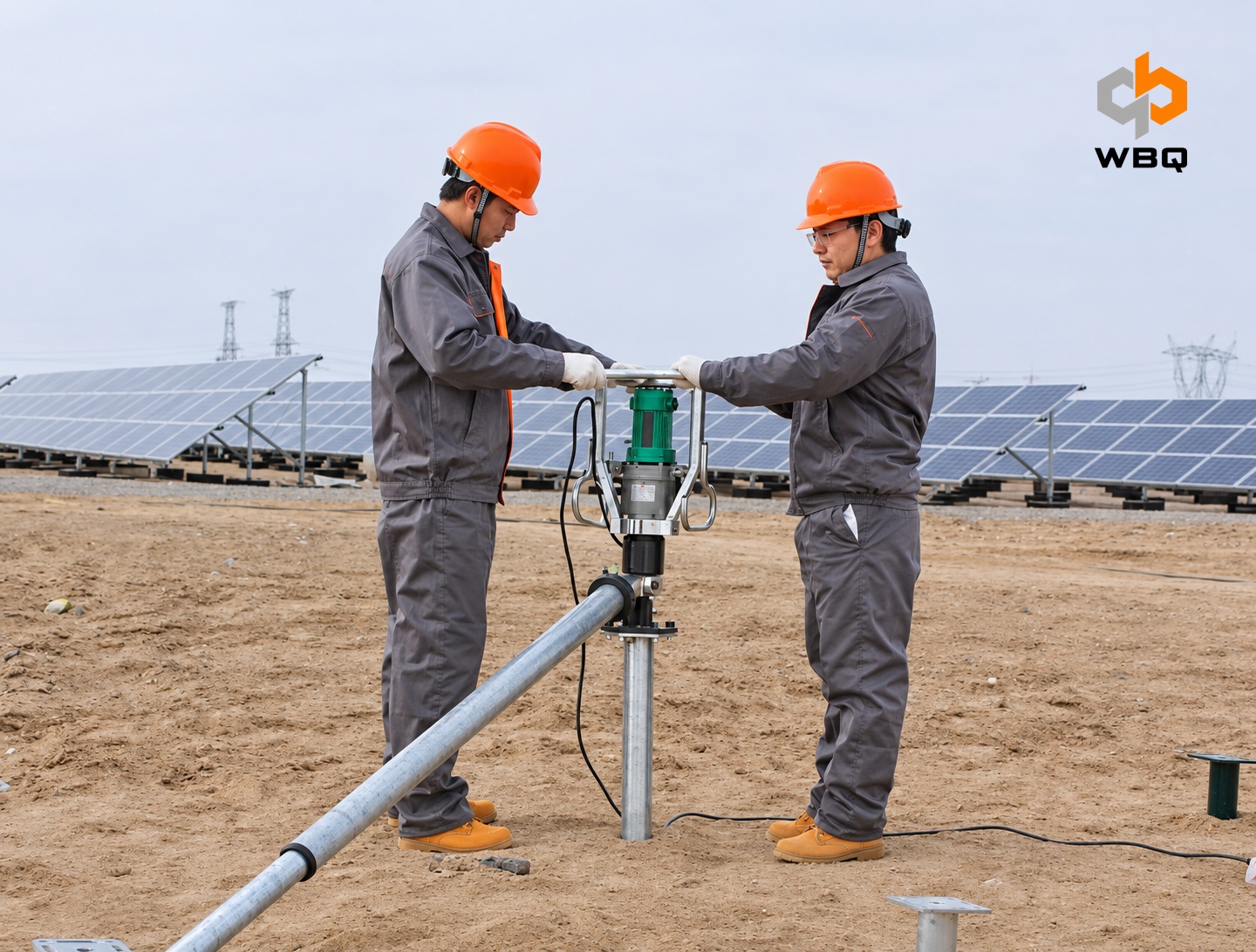
Small-Batch and Scattered Ground Screw Installations
For projects involving a limited number of ground screws or installation points spread across a site, mobilizing large construction machinery may not be necessary.
Examples include small-scale solar foundation work, foundations for individual structures, and scattered ground screw installations.
In these situations, portable electric equipment may offer a practical installation option, provided the ground screw and equipment specifications are compatible.
Sites with Restricted Access for Larger Machinery
Gardens and landscaped areas, narrow access routes, spaces around existing buildings, and some waterfront boardwalks or sloped sites can restrict the use of larger machinery.
Where access for larger equipment is limited, a portable electric pile driver may provide an alternative for ground screw installation, provided there is a suitable working position and the equipment meets the installation requirements.
For waterfront and sloped sites, operator positioning, equipment support, and power supply safety should be assessed before work begins. The fact that equipment is portable does not automatically make it suitable for every restricted-access location.
Fence Foundations and Selected Light-Structure Applications
Ground screws are also used for fences, railings, some timber buildings, and light steel structures.
For these applications, a portable electric pile driver may be considered when the ground screw design, dimensions, and installation requirements match the equipment.
The structure type alone does not determine which driver should be used. Even fencing projects can require different installation arrangements depending on the ground screw design and site conditions.
Manual, Electric and Hydraulic Ground Screw Installation Compared
Ground screws can be installed using manual tools, portable electric equipment, or hydraulic-powered equipment. The three methods differ in their power sources, equipment arrangements, and suitable applications.
| Comparison | Manual Installation | Portable Electric Equipment | Hydraulic Equipment |
| Power Source | Manual force | Electric motor | Hydraulic system |
| Equipment Setup | Hand-operated tools | Portable electric equipment | Hydraulic power head and compatible carrier machine |
| Suitable Applications | Small quantities of ground screws confirmed as suitable for manual installation | Small batches, scattered pile locations, and some restricted-access areas | Mechanized rotary installation where a compatible carrier machine is available |
| Main Requirements | Manual workload and site conditions | Equipment capability, power supply, and operating conditions | Carrier-machine hydraulic parameters, connection interfaces, and site operating conditions |