





Blog
How to Specify Corrosion Protection for Ground Screws in Solar PV Projects
Date: 2026-11-17
A purchase specification for ground screws may call for hot-dip galvanizing and a minimum coating thickness. But are these requirements sufficient for a foundation that will remain buried in the soil?
For solar PV projects, corrosion protection should be specified based on site conditions, foundation design life, and the applicable standards. The resulting requirements form the basis for procurement, manufacturing, and inspection.
Why Site Conditions Matter for Ground Screw Corrosion Protection
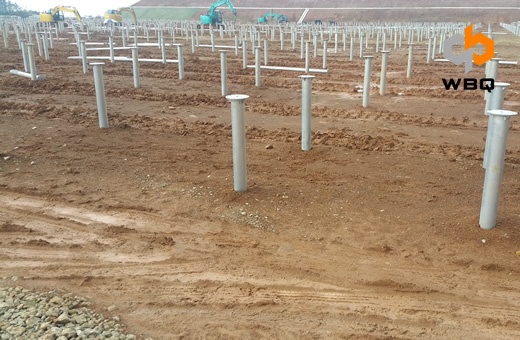
Once installed, most of the ground screw is below grade, while the top connection and part of the shaft may remain exposed above ground.
The buried section is exposed to soil and, depending on site conditions, groundwater. Above ground, the steel is exposed to rainfall, atmospheric moisture, and airborne contaminants. Conditions near ground level may differ from those deeper in the soil due to standing water and repeated wetting and drying.
Hot-dip galvanizing protects the steel by forming a barrier against the surrounding environment. Under suitable conditions, it also provides electrochemical protection to small areas of exposed steel. The zinc coating itself, however, is gradually consumed during exposure.
Once a solar farm is operational, its buried foundations are difficult to inspect or maintain. Corrosion protection is therefore a design-stage consideration, rather than a surface treatment decision made after the ground screw has been specified.
Assessing Soil and Groundwater Corrosivity
A geotechnical investigation provides essential information for foundation design, but the data used to assess soil bearing capacity may not be sufficient to evaluate soil corrosivity toward steel and zinc coatings.
Consider two sites with sandy soils. One drains freely, while the other has a high water table and elevated levels of soluble salts. Despite their similar soil classification, the two sites may present very different corrosion conditions.
Soil moisture content and drainage are particularly relevant in low-lying areas, certain clay soils, and locations subject to seasonal waterlogging. The corrosivity assessment should account for changes in moisture conditions and groundwater levels throughout the year.
Soil pH, chloride content, and resistivity also help characterize the corrosion environment. Strongly acidic or highly alkaline conditions can adversely affect zinc coatings, while elevated chloride levels may accelerate corrosion under moist conditions. Soil resistivity indicates the soil's resistance to electrical current and should be evaluated alongside moisture content, soluble salts, and soil chemistry.
On a large solar farm, soil and groundwater conditions can vary across the site and with depth. Corrosion protection requirements should be based on representative site investigation and testing data rather than measurements from a single location.
If ground screw drawings are available at the request for quotation (RFQ) stage but corrosivity data are incomplete, preliminary discussions about product specifications and supply conditions can still proceed. The responsible design professionals should establish the final corrosion protection requirements once the site conditions and design requirements are sufficiently defined.
Specifying Hot-Dip Galvanizing and Coating Thickness
Ground screws can be hot-dip galvanized as complete fabricated assemblies after the steel tube, helix, and connection components have been welded together.
For fabricated steel articles of this type, projects in China may specify GB/T 13912-2020, where applicable. Projects in other markets should follow the relevant local requirements and contractual specifications, which may reference DIN EN ISO 1461:2022-12 or another applicable standard.
The required coating thickness depends on the thickness of the underlying steel and the category of article being galvanized.
The following table shows selected minimum coating thickness requirements for non-centrifuged steel articles under the German standard DIN EN ISO 1461:2022-12.
|
Steel thickness, t (mm) |
Minimum local coating thickness
(μm) |
Minimum mean coating thickness
(μm) |
|
1.5 ≤ t ≤ 3 |
45 |
55 |
|
3 < t ≤ 6 |
55 |
70 |
|
t > 6 |
70 |
85 |
Source: DIN EN ISO 1461:2022-12, Table 3.
For example, a 4 mm thick steel article covered by the general requirements has a minimum local coating thickness of 55 μm and a minimum mean coating thickness of 70 μm. Any special provisions applicable to the steel or article concerned must also be considered when establishing acceptance criteria.
When using a magnetic thickness gauge, the local coating thickness is the average of the specified number of measurements taken within a reference area. It is not an individual thickness reading. The mean coating thickness is the average of the relevant local coating thickness values, determined in accordance with the standard.
Acceptance of an inspection lot must follow the applicable sampling and inspection requirements. A single gauge reading does not establish compliance for the entire lot.
A ground screw may incorporate a steel tube, a helix, and a flange of different material thicknesses. Under DIN EN ISO 1461:2022-12, coating thickness requirements are based on the applicable steel thickness ranges. Reference areas for inspection must be selected in accordance with the standard, taking into account the dimensions and configuration of the article. The procurement specification should also identify any areas requiring separate coating thickness control.
For more on shaft wall thickness and material selection, see our guide to ground screw dimensions and steel grades.
For projects requiring thicker zinc coatings, WBQ can work with customers to assess the feasibility of supplying ground screws with coatings above the applicable minimum thickness requirements of GB/T 13912-2020 and DIN EN ISO 1461:2022-12, based on the product specifications and project requirements. The coating thickness and inspection requirements for each order are subject to the agreed technical documents.
The minimum requirements of a galvanizing standard do not necessarily meet the corrosion protection needs of a specific solar PV project. If the design calls for a thicker coating, the specification should identify whether the requirement applies to local coating thickness, mean coating thickness, or both. Steel chemistry, component geometry, and the galvanizing process should be considered when determining whether the specified thickness can be achieved.
Coating Thickness and Foundation Design Life
Under comparable exposure conditions, a thicker zinc coating generally provides longer corrosion protection. However, research published by the American Galvanizers Association (AGA) in The Service Life of Galvanized Steel Articles in Soil Applications shows that coating consumption can vary considerably between soil environments.
A coating that passes the inspections specified by a galvanizing standard will not necessarily provide the same duration of corrosion protection at different sites. Its protective life also depends on the exposure environment, initial coating thickness, and coating condition.
Zinc coating consumption is not, by itself, a measure of the ground screw's remaining load-bearing capacity. Corrosion-related loss of steel cross section may affect the structural performance of the shaft, helix, and connection components. Foundation design must account for such material loss where relevant to the expected exposure conditions.
For more aggressive environments or projects with longer required design lives, the design team may need to evaluate a thicker zinc coating, a corrosion allowance, or an additional protective coating. A corrosion allowance is additional steel thickness incorporated into the structural design to account for anticipated corrosion-related material loss. It serves a different purpose from the zinc coating.
The foundation design life must be established based on the site's corrosive conditions, the foundation structure, and the required long-term performance, rather than coating thickness alone.
Specifying Corrosion Protection in Ground Screw Procurement
When an RFQ simply specifies “hot-dip galvanized,” suppliers may quote different coating and inspection requirements, even for ground screws with identical shaft diameters, lengths, and wall thicknesses.
To obtain comparable quotations, procurement teams should include the project-specific corrosion protection requirements in the product drawings or technical specifications. These should identify the applicable standard and edition, coating thickness requirements, areas requiring special protection, and inspection criteria.
Before production, the buyer and supplier should confirm that any project-specific coating requirements or additional protective measures can be achieved and agree on how compliance will be verified on the finished product.
For details on fabrication, galvanizing, and finished product inspection, see our guide to ground screw manufacturing and quality checks.
Installation conditions also need to be considered. Gravel and other hard particles may cause localized coating damage as ground screws are rotated into the soil. Where this is a concern, the project should define the applicable field inspection and coating repair requirements in advance.
At delivery, coating thickness inspection records should be traceable to the products and inspection lots supplied. Acceptance criteria should match the technical documents agreed upon for the order.
The same approach applies to ground screws used for solar farm fencing, although their structural loads and design conditions may differ from those of solar mounting foundations.
WBQ supplies ground screws for solar mounting foundations and other engineering applications. To discuss your project, send us your ground screw drawings and specifications, available site investigation data, foundation design life requirements, and any specified corrosion protection requirements.
We can review the product configuration, coating requirements, and inspection criteria with your team. The final corrosion protection and acceptance requirements remain subject to the project design documents, applicable standards, and agreed technical specifications.